Benchmark
OpenRadioss Car · Crash
Engineering question: Can a surrogate predict transient surface displacement across thickness design variables in a frontal crash?
Full vehicle, frontal impact. Thickness on bumpers, oil pan, and pillars changes how the body folds over time. Transient crash response, not a static part study. The kind of problem lightweighting teams actually argue about.
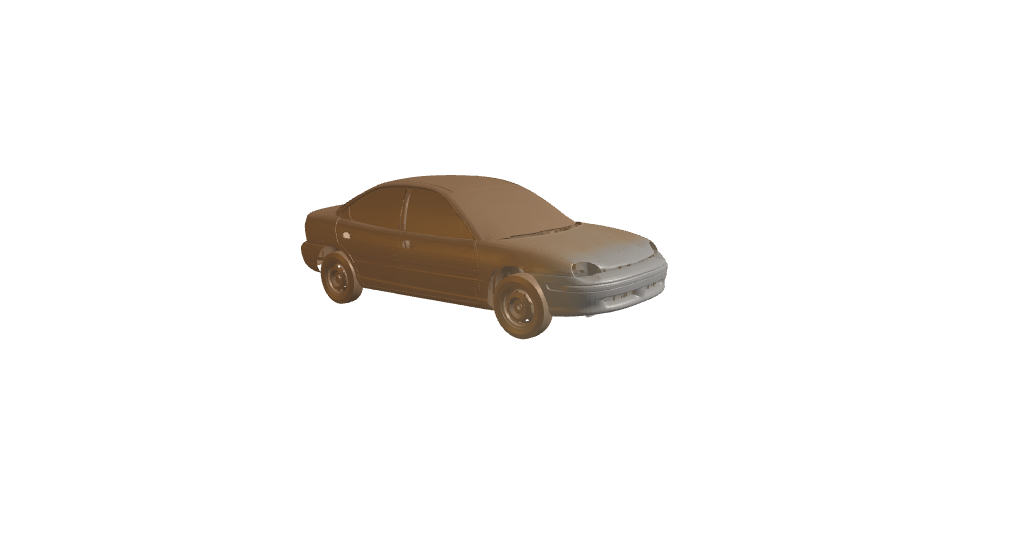
Thickness DOE reshapes how the body folds
- Industry
- Automotive crash
- Domain
- Crash / FEA
- Dataset
- OpenRadioss Neon
- Task
- Transient displacement
- Solver
- OpenRadioss
- Mesh
- ~50k surface nodes
- Train
- 32 cases
- Holdout
- 8 test cases
Scope and limits
Comparability
Transient crash on a reduced surface mesh, not comparable with steady CFD or static structural benchmarks. Scores use median field R² across timesteps within each holdout case.
Ground truth
OpenRadioss simulation exports from the public Neon benchmark lineage. Site study uses a ~50k-node surface subset; upstream decks trace to the 1M-element Neon model.
Open subset vs full corpus
This site hosts a 40-case open thickness DOE on a decimated Neon surface mesh, not the full upstream volume model. The public OpenRadioss 1M Element Neon HPC benchmark uses on the order of one million elements in native Radioss decks. We kept only the outer surface, decimated to about 50k nodes, so surrogate training and holdout scoring stay tractable without multi-day runs on full-vehicle volume meshes. Strong scores on this split do not automatically mean strong performance on the full Neon corpus.
Architectures excluded
Two-Stream Transformer and DoMINO are not listed here. Crash uses FE transient (fea-deform) time-series displacement on the surface mesh. TST and DoMINO target steady CFD and single-frame surface or volume fields, not transient structural sequences.
Submissions
Published scores from models trained on the open crash split and evaluated on shared holdout thickness DOEs. Expand a row for per-case displacement R².
Select submissions to compare
| Compare | Model | Submitted | Train time | Disp. R² | Details |
|---|---|---|---|---|---|
| GeoTransolver984c9 | Jul 8, 2026 | 1h 45m 0s | 0.9787 | ||
| MeshGraphNet84260 | Jul 13, 2026 | 12h 6m 40s | 0.5047 |
Ready to try this out? Download the training split, or submit if you already trained on the shared protocol. Check the submission guide →